Best Baby Thermometers UK: Ear, Forehead & Room Compared
Four UK baby thermometers compared (£19.99 to £40): Braun ThermoScan 7+ ear, Beurer FT90 forehead, Tommee Tippee Groegg2 room and InBath models. Includes the NHS underarm method, fever thresholds by age, a decision table and common mistakes.
The best baby thermometers for most UK homes are a digital underarm thermometer, which is the type the NHS describes, plus a separate room thermometer for the cot. We compare four we list, from £19.99 to £40, covering ear, forehead, bath and room models, and explain how to take a reading and when a number means calling NHS 111.
Winter is when coughs, colds and nursery bugs return, and a baby who feels warm at 2am is the moment most parents wish they had a thermometer in the drawer. This guide is about choosing one. For what the numbers mean and when to get help, see our baby fever guide based on NHS advice. For the rest of the medicine cabinet, see our list of what a baby first aid kit needs.
One honest note first. We have not used these products ourselves, so everything below comes from manufacturer specifications and our own product notes, and is hedged accordingly. Prices are typical UK prices at the time of writing and will move.
Four baby thermometers compared at a glance
Only two of these four measure your baby's own temperature. The other two measure the bath or the room, which is a different job, and the table makes that clear.
| Thermometer | Typical price | What it measures | How it works | Best for |
|---|---|---|---|---|
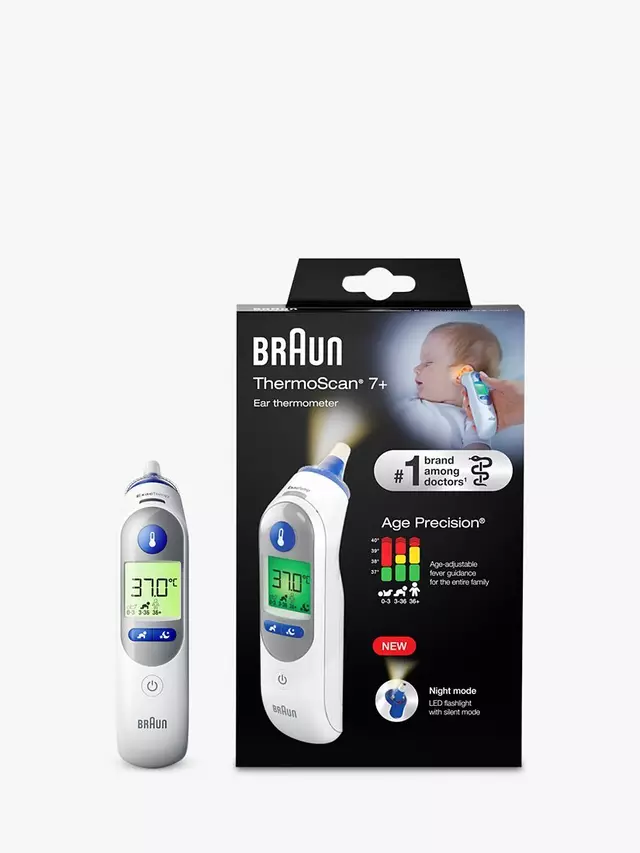
| Braun ThermoScan 7+ | £40 | Baby's temperature | Ear (tympanic), pre-warmed tip, about one second, colour-coded by age | The one main thermometer for the whole family |
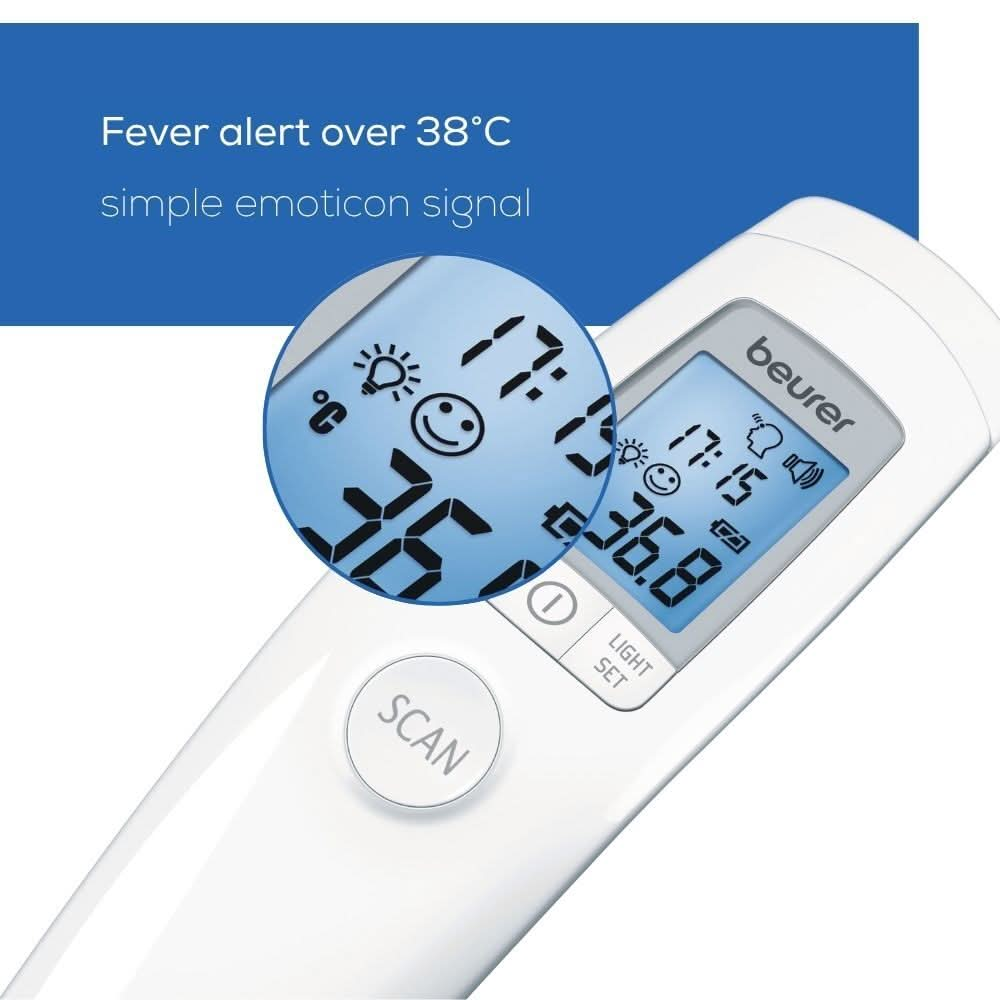
| Beurer FT90 | £22.50 | Baby's temperature (also room and surface) | Non-contact infrared forehead, under a second, 60-reading memory | A quick check on a sleeping baby, or a second thermometer |
| Tommee Tippee Groegg2 | £20 | Room temperature | Colour-changing egg: blue, green or amber | An at-a-glance nursery check |
| Tommee Tippee InBath Digital | £19.99 | Bath water, and room | Floating digital readout, AAA battery | Bath time, then a room thermometer between baths |
What the NHS says about taking a baby's temperature
The NHS recommends a digital thermometer, sold in pharmacies and supermarkets. It says to place the tip in the top of the armpit, gently close the arm over it so it stays pressed against the body, and leave it for as long as the instructions say, as some thermometers beep when ready. If your child has just had a bath or been wrapped in a blanket, it suggests waiting a few minutes and trying again (NHS).
That NHS page does not discuss ear or forehead thermometers, so we can't tell you the NHS prefers one over another. What it does give is the thresholds that matter: it defines a high temperature as 38°C or more, and says to call NHS 111 for a baby under three months with a temperature of 38°C or higher, or a baby aged three to six months with a temperature of 39°C or higher (NHS). Whichever thermometer you buy, check it reads in degrees Celsius and that you can see the number clearly in a dark bedroom.
Braun ThermoScan 7+: the best all-rounder
The Braun ThermoScan 7+ is the most expensive of the four at about £40 and the one we would pick if you are buying a single thermometer. It is an ear thermometer. According to our product notes, ear readings are generally considered more consistent than forehead scanning, and Braun's pre-warmed tip and roughly one-second scan are aimed at shortening the struggle with a wriggling baby.
Its standout feature is an age-precision setting that adjusts the colour guidance (green, yellow, red) to your child's age band. That removes some of the arithmetic at 3am, though you should still know the NHS numbers above rather than rely on a colour alone.
Watch out for: the ear needs a good seal, which is harder on an upset baby, and disposable probe covers are an ongoing cost. Budget for replacement packs rather than treating £40 as the full price of ownership. Read the manufacturer's guidance on the youngest age it is suitable for, and if a result surprises you, wait a few minutes and retake it.
Beurer FT90: the budget no-touch option
The Beurer FT90 is held a few centimetres from the forehead and, per the manufacturer's specification, reads in under a second without touching the skin. For a newborn who hates anything near their face or ear, or a baby you do not want to wake, that is its appeal. It also doubles as a room and surface thermometer, stores 60 readings, and shows a smiley or frown icon beside the number.
At about £22.50 it costs roughly half the Braun. The trade-off, as our product notes put it, is that non-contact infrared thermometers are generally considered less precise than ear models and more sensitive to draughts, ambient temperature and a sweaty forehead. We would treat it as a quick screening tool, or a good second thermometer for a nursery or grandparents' house. Stick to an established brand: cheap unbranded non-contact thermometers sold online can be inconsistent. If the reading looks high and your baby seems unwell, confirm with a second reading before you decide what to do, and follow the NHS thresholds above.
Tommee Tippee Groegg2: the nursery room check
The Groegg2 (about £20) does not take your baby's temperature at all. It glows blue for too cold, green for the recommended 16 to 20°C range and amber for too warm, which fits directly with safer sleep advice. The Lullaby Trust says to keep a baby's room at 16 to 20°C and use a room thermometer, because guessing the temperature is difficult (Lullaby Trust).
The limitation is worth stating plainly: a green room does not guarantee your baby is dressed correctly for it. The Lullaby Trust suggests checking your baby by feeling their chest or the back of their neck, noting that hands and feet are usually cooler, and removing a layer if the skin feels hot or sweaty (Lullaby Trust). Our winter baby room temperature guide covers what to dress them in. If you would rather see an exact figure, many baby monitors show a temperature readout, though it is still worth checking against a separate thermometer.
Tommee Tippee InBath Digital: bath time and the nursery
The InBath Digital (£19.99) floats in the bath and gives a digital readout, then lifts out to serve as a room thermometer. It needs an occasional AAA battery. The NHS says bath water should be warm, not hot, to run the cold water first and then add the hot, to mix it well so there are no hot patches, and to check it with your wrist or elbow (NHS). A thermometer is a useful second check when you are exhausted, not a replacement for the wrist or elbow test. See our baby baths and bath supports comparison for the rest of the bathtime kit.
Which one should you buy? A decision table
| Your situation | Our pick | Why |
|---|---|---|
| One thermometer for a newborn and beyond | Braun ThermoScan 7+ | Ear reading with age-based colour guidance, built for babies and children |
| Tight budget, want a quick check | Beurer FT90 | Around half the price, no contact, works on a sleeping baby |
| Worried about the nursery being too warm | Groegg2 or InBath | Room temperature against the 16 to 20°C range |
| Following the NHS method exactly | Any digital underarm thermometer | The only type the NHS page describes, usually cheap at pharmacies |
A sensible low-cost kit for a newborn is a basic digital underarm thermometer (the NHS method) and one room thermometer, with a Braun or Beurer added if you want a faster reading. You can keep track of what you have bought on your baby checklist, and browse more health essentials in our baby first aid and health roundup.
Common mistakes when taking a baby's temperature
- Reading straight after a bath or while wrapped up. The NHS says to wait a few minutes in these cases, because the reading can be falsely high (NHS).
- Relying on a room thermometer to tell you the baby's temperature. Room and baby readings are different things. The Groegg2 and the bath thermometer do not replace a body thermometer.
- Using the wrong units or ignoring age. The NHS thresholds are different for under-three-months (38°C) and three-to-six-months (39°C), so know your baby's age band.
- Sponging a feverish baby or adding layers. The NHS says not to undress or sponge a child down to cool them, and to avoid covering them in too many clothes or bedclothes (NHS).
- Skipping hygiene. Clean the thermometer as the instructions say, and replace ear probe covers.
- Trusting a number over your instincts. The NHS says to get medical advice if you are worried or if paracetamol or ibuprofen is not helping. A baby who is unusually drowsy, not feeding or just not themselves needs attention whatever the thermometer says.
When a reading means getting help
This is general information, not medical advice. The NHS says to call 111 for a baby under three months with a temperature of 38°C or higher, or aged three to six months with 39°C or higher, or if you think they have a high temperature. It also lists a fever lasting five days or more, a rash alongside the fever, not wanting to eat or signs of dehydration. It says to call 999 for a stiff neck, a rash that does not fade under a glass, a first seizure, difficulty breathing, changes in skin or lip colour, or being drowsy and hard to wake (NHS). The NHS also notes that paracetamol should not be given to a child under two months, and ibuprofen not to a child under three months or under 5kg; follow the pack and ask a pharmacist or GP. Our fever guide sets this out in full.
Where a thermometer fits in your newborn shopping list
A thermometer is a cheap, boring purchase that is well worth having before you need it, because the shops are closed at 2am. Buy before the birth if you can, and put it somewhere you can find it in the dark. Beyond that, resist the urge to buy several gadgets: one reliable body thermometer and one room thermometer cover almost every real situation. Our guide to baby gear you do not actually need is a good check against an overfull basket.
Mentioned in this guide
Frequently asked questions
What is the best thermometer for a baby UK?+
The NHS describes using a digital thermometer under the armpit, sold in pharmacies and supermarkets, and does not recommend one brand. If you want a faster option, the Braun ThermoScan 7+ is an ear thermometer built for babies and children, at about £40, while the Beurer FT90 is a cheaper non-contact forehead model at about £22.50. For most families a basic digital underarm thermometer plus a separate room thermometer is enough. Whichever you pick, learn the NHS thresholds first: 38°C or higher under three months, or 39°C or higher at three to six months, means calling NHS 111.
What temperature is a fever in a baby?+
The NHS says a high temperature in a child is 38°C or more, and that it usually returns to normal within one to four days. How urgently to act depends on age. The NHS says to call 111 for a baby under three months with a temperature of 38°C or higher, or aged three to six months with 39°C or higher, or if you think they have a high temperature. It also says to call 111 if the fever has lasted five days or more, or if there are other signs of illness such as a rash. This is general information; if you are worried, call 111 or your GP.
Where should you take a baby's temperature?+
The NHS says to use a digital thermometer in the top of the armpit, close the arm gently over it and keep it pressed against the body for as long as the instructions say. If your baby has just had a bath or been wrapped in a blanket, wait a few minutes and try again, as the reading may be falsely high. The NHS page does not cover ear or forehead thermometers, so if you buy one, follow the manufacturer's instructions, including the minimum age it is suitable for, and retake the reading if the result looks surprising.
Do I need a room thermometer for the nursery?+
The Lullaby Trust advises keeping a baby's room at 16 to 20°C and using a room thermometer, because it is difficult to judge the temperature by guessing. A colour-changing model such as the Groegg2 or a digital bath and room thermometer both work. A room thermometer only tells you about the room: the Lullaby Trust says to check your baby by feeling their chest or the back of their neck, that hands and feet are usually cooler, and to remove a layer if their skin feels hot or sweaty.
Are forehead thermometers accurate for babies?+
Our product notes describe non-contact infrared thermometers as generally considered less precise than ear thermometers, and more sensitive to draughts, ambient temperature and a sweaty forehead. They are quick and can be used on a sleeping baby, so they suit a quick screening check or a second thermometer. The NHS page on fever in children describes only the digital underarm method, so we can't cite it for or against forehead models. If a forehead reading looks high and your baby seems unwell, take a second reading and use the NHS thresholds, or call NHS 111.
Sources
Related guides
Cot Mattress UK: What to Check Before You Buy (2026)
Black Friday is a good moment to buy a cot mattress, but only if it passes the safety basics. The NHS and Lullaby Trust say it should be firm, flat, waterproof-covered and fit the cot with no gaps. Here is the checklist, a comparison of mattress types, second-hand rules and the sale-season traps to avoid.
BlueMello Swaddle Blanket Recall (Amazon): OPSS Warning
OPSS has recalled the BlueMello Baby Swaddle Blanket sold on Amazon because a baby can slip below the covers, risking overheating and airway obstruction. Here is what to do, how to check any swaddle, and safer UK alternatives.
Baby Sleep Away From Home at Christmas: UK Safe Guide
Staying with family over Christmas? Here is how to set up safe sleep for your baby away from home: checking a borrowed cot and mattress, using a travel cot, handling car seats and sofas, and what to pack, with NHS and Lullaby Trust guidance.

Written by
Sepehr
Software engineer, soon-to-be dad, uncle to four — the tech-obsessed half of the two of us testing this stuff. Currently building this site with my wife, ahead of our own baby arriving.