Best Baby Stair Gates Compared (UK Guide)
Six baby stair gates compared on price, fitting and closing: BabyDan Guard Me, Lindam Sure Shut Orto, Safety 1st, Dreambaby Chelsea, Regalo Easy Step and Hauck Squeeze Handle. Includes NHS and RoSPA advice on BS EN 1930:2011 and where to fit gates.

The best baby stair gate for the top of the stairs is a screw-fitted gate, and the best choice for most other openings is a BS EN 1930:2011 pressure-fit gate. Of the six gates we list, the BabyDan Guard Me (around £44.99) is the one built for the top of a staircase, the Lindam Sure Shut Orto (around £46.90) is the all-round pressure-fit pick, and the Hauck Squeeze Handle (£29.99) is the budget option. The NHS says to use gates that comply with BS EN 1930:2011 and to keep using them at the top and bottom of the stairs until your child is at least 2. For the fitting question in more depth, see our pressure-fit vs screw-fit stair gates guide, and for timing, do you need a stair gate and when to fit one.
What the NHS and RoSPA say about stair gates
The NHS says to fit safety gates that comply with British Standard BS EN 1930:2011 to stop a crawling baby getting onto stairs, and to close the gates properly after you go through them. For toddlers it says to carry on using safety gates at the top and bottom of the stairs until your child is at least 2 years old, and that you should never let a young child go up and down stairs alone, as even 4-year-olds may need some help.
RoSPA gives the same advice: fit a safety gate to BS EN 1930:2011 at the top and bottom of stairs. Its child-development table recommends stair gates for 1 to 2-year-olds, the age when children reach for things high up and climb, and says children should never be left alone. RoSPA also reports that around 10 children die as a result of falls each year, some from windows and balconies and the remainder mostly from stairs. Those figures come from older sources, so treat them as a general indication.
The NHS also says that gaps between banisters or balcony railings wider than 6.5cm (2.5 inches) should be covered with boards or safety netting, because small babies may be able to squeeze through. A gate does not make a gappy banister safe.
Neither NHS nor RoSPA pages we read say which fitting type to use at the top of the stairs. That advice comes from manufacturers, whose instructions say screw-fit gates are intended for stair tops. Always follow the instructions for the specific gate, and check the label for the BS EN 1930 marking before you buy.
Stair gates compared
| Gate | Price we list | Fitting | Closing | Best for |
|---|---|---|---|---|
| BabyDan Guard Me Auto Retractable | Around £44.99 | Screw-fit | Auto-close, auto-lock | Top of the stairs |
| Lindam Sure Shut Orto | Around £46.90 | Pressure-fit | One-handed adult opening | Everyday doorways and hallways |
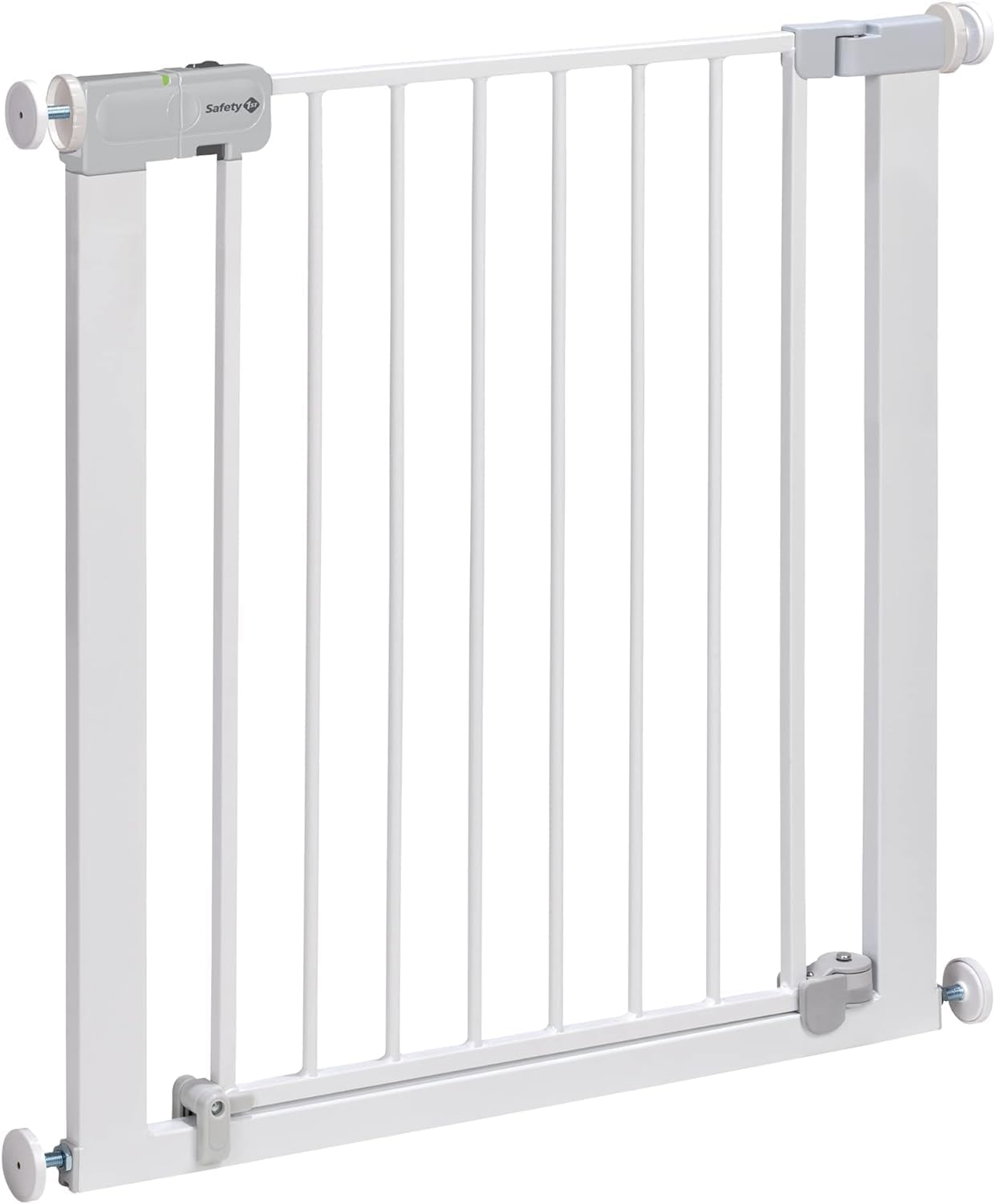
| Safety 1st Auto Close (Simply Secure) | Around £44.99 | Pressure-fit, metal | Auto-close | A single standard-width opening |
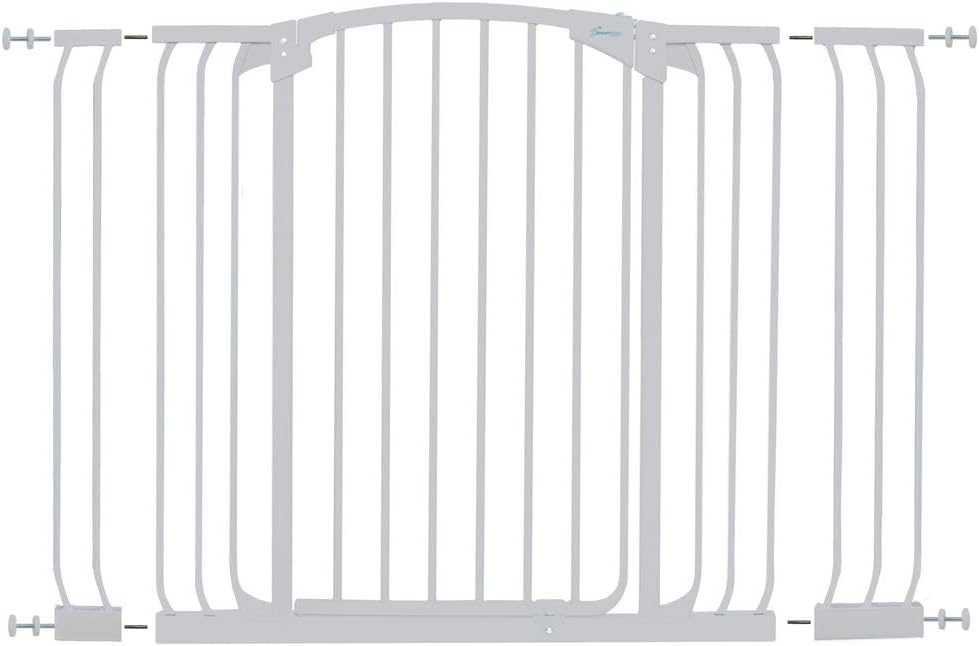
| Dreambaby Chelsea Xtra-Tall & Wide | Around £49.99 | Pressure-fit | Auto-close | Climbers, big dogs, wide gaps |
| Regalo Easy Step Extra Tall | £44.99 | Pressure-fit (wall-mount hardware supplied) | Manual walk-through | Taller gate, wider fit range |
| Hauck Squeeze Handle | £29.99 | Pressure-fit with fixing screws | Manual, two-button handle | Tight budgets |
Prices are what we list and change often, so check the retailer. We have not hands-on tested any of these gates, so everything below comes from manufacturer specifications and published information rather than our own use. Heights, width ranges and fitting methods are as specified and should be checked against your own opening before you buy.
Best for the top of the stairs: BabyDan Guard Me (around £44.99)
The Guard Me is a screw-fit gate, bolted into the wall or banister rather than held by pressure alone, which is why it is the one we would look at for the top of a staircase. Its auto-close, auto-lock mechanism means it is not left open by accident, which matters most at that spot. The trade-off is installation: you have to drill, and removing it leaves fixing holes. If you rent, check with your landlord first.
Best all-rounder: Lindam Sure Shut Orto (around £46.90)
One of the most widely used pressure-fit gates in the UK, with a one-handed opening mechanism designed to be usable while you carry a baby but tricky for a toddler to work out. Pressure-fit means no drilling, so it suits rented homes and doorways. Compared with the Guard Me it is quicker to fit and fully removable, but it is not the type to rely on at the top of the stairs.
Best simple budget gate: Safety 1st Auto Close, Pressure Fit (around £44.99)
A sturdy metal pressure-fit frame with a simple adult-opening latch. It does the core job for a single standard doorway or hallway. What you give up is extension range for wide openings and some of the smoothness of the Lindam mechanism.
Best for climbers and big dogs: Dreambaby Chelsea Xtra-Tall & Wide (around £49.99)
The extra height and wide extension range suit households where a determined toddler may start trying to climb a standard-height gate, or where a large dog shares the space. It is a little bulkier and costs a touch more than standard gates. It is auto-close, which helps with the NHS advice to close gates properly after you go through.
Best taller walk-through: Regalo Easy Step Extra Tall (£44.99)
Specced at 91cm tall, noticeably taller than the roughly 75 to 76cm of standard gates in this list, with a 4-inch extension kit included. It is a manual walk-through gate that does not self-close, so it relies on whoever goes through to shut it. That makes it a better fit for a hallway than for a stair top, unless you use the supplied wall-mount hardware, and even then it is worth reading the manufacturer's guidance on stair-top use.
Best on a tight budget: Hauck Squeeze Handle (£29.99)
The cheapest gate here is a straightforward pressure-fit barrier with a two-button squeeze-and-lift handle that opens both ways. It is specced at 76cm standard height with an optional extension kit taking it up to 109cm. There is no self-closing mechanism, so you must push it shut every time, and the plastic handle parts are the likely wear point over years of daily use. It suits a stopgap for a year or two better than a gate meant to last through several children.
How to choose and fit a stair gate
- Look for BS EN 1930:2011. This is the standard both NHS and RoSPA name. Do not buy a gate that does not state it.
- Match the gate to the location. Screw-fit at the top of the stairs, where a dislodged gate is most dangerous; pressure-fit is fine for most doorways and the bottom of the stairs, following the manufacturer's instructions.
- Measure the opening before you buy, including skirting boards, and check the gate's width range and extension kits.
- Close it every time. The NHS says to close gates properly after you go through them. Auto-close models help, but check the latch clicks.
- Check regularly. Make a habit of testing the fit, latch and any screws, as gates can loosen with daily use.
- Do not rely on the gate alone. Keep stairs clear of toys, hold the handrail when carrying your baby, and cover banister gaps wider than 6.5cm, as the NHS advises.
Once your child is climbing out of cots, our baby-proofing checklist room by room covers the rest of the house.
Related guides
- Best Baby Highchairs Compared (UK Guide)
- Best Baby Sun Protection Compared: Cream, Hats & Swimwear
- Best Baby Cups and Weaning Bibs Compared (UK)
- Our ranked picks for this category
Keep track of what you have, want and don't need with My List, and share what's left as a baby registry your guests can claim from without signing up.
Mentioned in this guide
Frequently asked questions
Do I need a stair gate at the top and bottom of the stairs?+
Yes. The NHS and RoSPA both say to fit BS EN 1930:2011 gates at the top and bottom of stairs, and the NHS says to keep using them until your child is at least 2.
What is BS EN 1930:2011?+
It is the British and European standard for child safety barriers for domestic use. The NHS says to fit gates that comply with it, and RoSPA lists it too.
Should a stair gate be screw-fit or pressure-fit?+
Manufacturers specify screw-fit gates for the top of the stairs, where a dislodged gate is most dangerous. Pressure-fit gates suit most doorways. Follow the instructions for your gate.
At what age can I stop using a stair gate?+
The NHS says to carry on using gates at the top and bottom of the stairs until your child is at least 2, and that even 4-year-olds may need help on stairs.
Are stair gates enough to make the stairs safe?+
No. The NHS also advises holding the handrail when carrying your baby, keeping stairs clear of toys, and covering banister gaps wider than 6.5cm.
Sources
Related guides
Baby Humidifier UK: Do You Need One? NHS Safety Guide
Do you need a baby humidifier this winter? NHS cold advice doesn't recommend one. We explain scald, mould and overheating risks, compare types, and give a safer checklist if you still want one.
Britax Römer SMILE Pushchair Recall: Check Front Wheels
OPSS and Britax Römer have recalled the SMILE III, SMILE 4 and some SMILE 5Z pushchairs because the front wheel locking mechanism can wear and the wheel may detach. Here is which models are affected, the two-minute wheel check, and what to do next.
Christmas Dinner for Babies and Toddlers: What's Safe (UK)
A plate-by-plate guide to Christmas dinner for babies and toddlers in the UK, built on NHS advice: which foods are fine, what to leave off (honey, salty gravy, whole nuts), how to cut food safely and what to do if baby chokes.

Written by
Sepehr
Software engineer, soon-to-be dad, uncle to four — the tech-obsessed half of the two of us testing this stuff. Currently building this site with my wife, ahead of our own baby arriving.