Baby Nests and Sleeping Pods: Are They Safe?
The NHS says sleeping pods and nests are not advised because of their raised, cushioned sides, and the Lullaby Trust says to avoid them as sleep spaces. Here is what the guidance says, why the marketing misleads, what to use instead and what to do if you already own one.
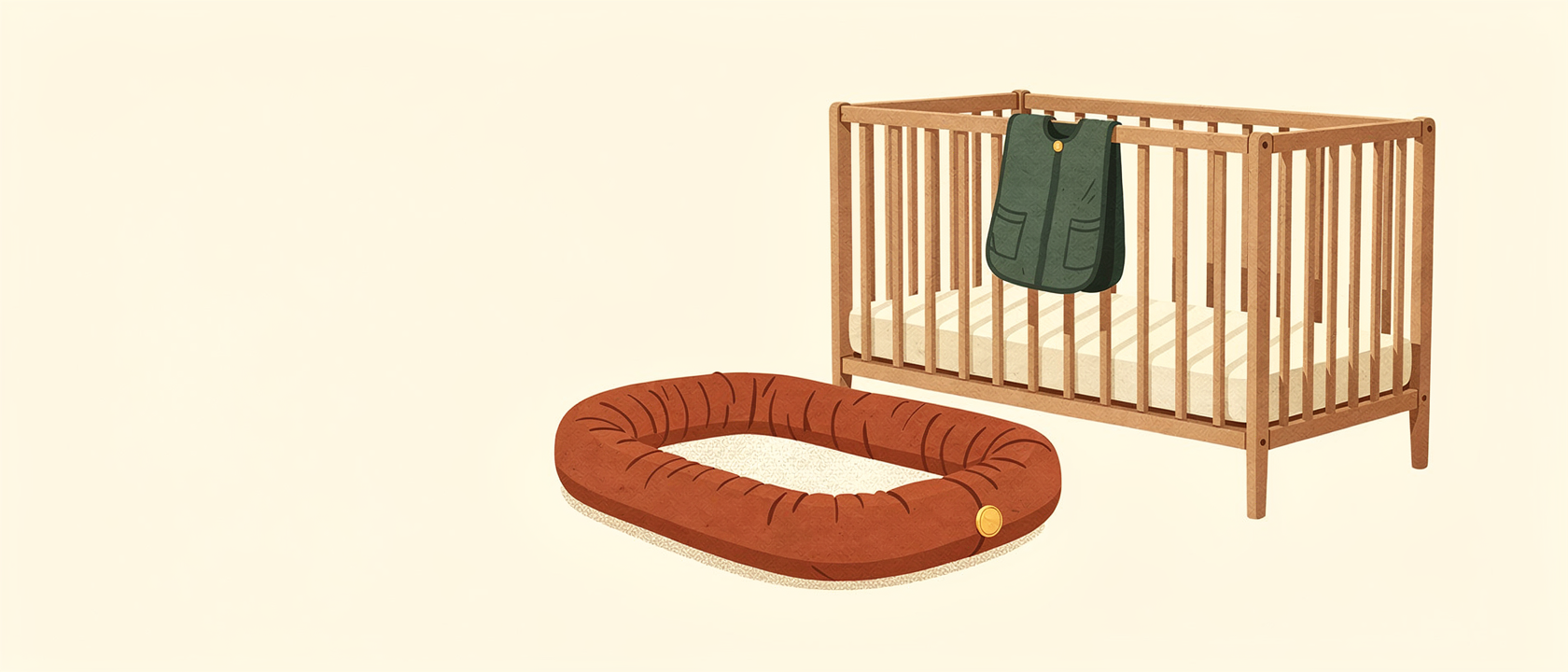
Baby nests and sleeping pods are not recommended as a place for a baby to sleep. The NHS says plainly that “sleeping pods or nests are not advised as they have raised or cushioned areas”, and the Lullaby Trust advises parents to avoid soft-sided pods and nests as sleep spaces. They are still widely sold, often with reassuring words like “breathable” or “comforting” on the listing — which is exactly why it is worth knowing what the guidance says before you buy or accept one as a gift.
What is a baby nest or pod?
A baby nest (sometimes called a pod, cocoon or snuggle bed) is a padded, oval or U-shaped surface with raised, cushioned sides, designed to make a baby feel “held”. Some are sold as portable beds to go inside a cot or Moses basket; others are marketed as lounging or co-sleeping aids. Baby hammocks are a related category. The common thread is a soft, shaped surface rather than a firm, flat one.
What the NHS and Lullaby Trust say
The NHS safe sleep advice is that the safest place for your baby to sleep for the first 6 months is in a cot, lying on their back, in the same room as you, on a firm, flat, waterproof mattress. It lists cot bumpers, pillows and loose bedding as things to avoid, and says sleeping pods or nests are not advised.
The Lullaby Trust goes into the reasoning:
- Airway risk: soft, squishy materials can cover a baby’s mouth and nose if pressed against them.
- Overheating: pods and nests are soft with raised or cushioned sides, which can cause a baby to overheat, and the charity links overheating to an increased risk of sudden infant death syndrome (SIDS).
- No standard: there is a British Standard for cot mattresses, but none for pods or nests as a sleeping place for babies. A product looking official or being sold by a well-known shop is not evidence that it meets any sleep-safety test.
This is not a new position. The Lullaby Trust warned in 2018 that nests, pods, hammocks, cot bumpers, pillows, duvets and anything that wedges or straps a baby in place go against safer sleep guidance, even when sold by trusted brands on the high street.
Why the marketing is so persuasive
In its Safer Sleep Week 2026 research, the Lullaby Trust reported that 95% of parents feel confident about baby sleep safety, yet only 5% correctly identified all safer sleep set-ups shown to them, and 51% said their baby sleeps in at least one product that goes against safer sleep guidance. Its chief executive, Jenny Ward, pointed to marketing: parents are “surrounded by products promoted as ‘comforting’, ‘breathable’ or ‘essential’”, which can give false security.
In practice, watch for these phrases on a listing: “womb-like”, “cocoon”, “breathable sides”, “newborn sleep positioner” and “portable bed for 0–12 months”. None of these replaces the basic rule of a firm, flat surface. It also connects to the wider OPSS concern about products that claim to help babies sleep — see our piece on why sleep wedges and positioners are never safe, and the RoSPA warning covered in what to stop using.
Nest vs Moses basket: what’s the difference?
It is an easy mix-up, because both are small, portable and cosy-looking. The difference is that a Moses basket is a recognised sleep product with its own British Standard — the Lullaby Trust and OPSS campaign material lists BS EN 1466:2014 for Moses baskets — and it is used with a firm, flat, waterproof mattress. A nest has no equivalent standard for sleep and is built around soft, raised sides. If a nest is sold as an insert to put inside a cot or Moses basket, that is the very set-up the guidance says to avoid, because it adds soft, raised areas to a surface that should be flat and clear. The OPSS and Lullaby Trust’s shorthand is a useful one to remember: “the safest cot is a clear cot”.
What to use instead
The Lullaby Trust recommends a cot, Moses basket or travel cot with a firm, flat, waterproof mattress. Its checks for the mattress are:
- firm — your baby’s head should not sink in more than a few millimetres;
- entirely flat, with no raised or cushioned areas;
- a waterproof cover;
- a mattress that meets the relevant British Standard (the Lullaby Trust cites BS 7177:2008+A1:2011 and BS EN 16890:2017+A1:2021).
If you want your baby to feel snug, the Lullaby Trust points to a well-fitting baby sleep bag, which stops a baby wriggling down under covers. The charity says to check the bag fits closely around the neck and shoulders so the head cannot slip inside, and to look for BS EN 16781:2018. Not sure which bed suits your space? Our guide to cot vs cot bed vs Moses basket covers the trade-offs, and the full newborn safe sleep guide pulls the NHS and Lullaby Trust advice together.
If you already own or were given a nest
Do not use it as your baby’s sleep space, including for naps. The Lullaby Trust’s guidance doesn’t set out advice on using nests while a baby is awake, so we can’t point to an official “safe when supervised” rule — if you are tempted to keep one for daytime lounging, treat it with caution and never leave a baby on it unattended, and move them to a flat sleep surface the moment they look drowsy. Also remember that babies often fall asleep unexpectedly, which is why the NHS stresses that falling asleep with your baby on a sofa or chair can increase the risk of SIDS substantially.
If you were sold a product marketed specifically for baby sleep, OPSS’s related alert on baby sleep pillows notes you may have consumer rights and should contact the supplier. It is also worth checking GOV.UK product recalls before buying anything second-hand for a sleep space.
Quick checklist before buying any sleep product
- Is the surface firm, flat and waterproof, with no raised or cushioned sides?
- Does it carry a relevant British Standard (cot, Moses basket, mattress or sleep bag), rather than just marketing claims?
- Is the cot clear — no pillows, bumpers, toys or loose blankets?
- Does the listing show a consistent age range and clear instructions?
- Has it been checked against current recalls on GOV.UK?
If in doubt, the simplest rule of safer sleep is also the cheapest: a clear cot, a firm flat mattress and your baby on their back.
Frequently asked questions
Are baby nests safe for sleeping?+
No. The NHS says sleeping pods or nests are not advised because they have raised or cushioned areas, and the Lullaby Trust advises avoiding soft-sided pods and nests as sleep spaces.
Can a baby sleep in a nest or pod at night?+
Not according to NHS and Lullaby Trust guidance. The safest sleep space is a cot, Moses basket or travel cot with a firm, flat, waterproof mattress, with your baby on their back.
Is there a safety standard for baby nests and pods?+
The Lullaby Trust says there is a British Standard for cot mattresses but no standard for pods or nests as a sleeping place for babies.
What should my baby sleep in instead of a nest?+
A cot, Moses basket or travel cot with a firm, flat, waterproof mattress. The Lullaby Trust also recommends a well-fitting baby sleep bag rather than loose blankets.
Sources
- NHS — Safe sleep advice for babies
- The Lullaby Trust — Baby sleeping products
- The Lullaby Trust — Warning about popular baby sleeping products sold in high street stores
- The Lullaby Trust — Safer Sleep Week 2026: misleading marketing
- GOV.UK / OPSS — Product Safety Alert: Baby Sleep Pillows (PSA8)
- GOV.UK — Product Safety Alerts, Reports and Recalls
- The Lullaby Trust — Baby sleep products campaign with OPSS
Related guides

Best Bedside Cribs & Moses Baskets Compared (UK)
Six bedside cribs and Moses baskets compared on price, size and lifespan: Silver Cross Lunar, Shnuggle Air Lite, SnuzPod4, HALO BassiNest, Chicco Next2Me Forever and a Mamas & Papas Moses basket. Includes the British Standards the Lullaby Trust lists and NHS safer sleep rules.
Best Baby Carriers Compared (UK Guide)
Six baby carriers compared on price, age range and carry positions: Ergobaby Omni 360, Tula Free-to-Grow, Izmi, BabyBjörn Carrier Mini, Close Caboo and Momcozy Move2Fit. Includes the Lullaby Trust and RoSPA T.I.C.K.S. safety checklist.
Bronchiolitis in Babies: Symptoms & When to Worry
Bronchiolitis is a common winter chest infection in babies. Here is what the NHS says about the symptoms, the signs that mean call 999 or 111, how to care for your baby at home, and how to lower the risk, including RSV protection.

Written by
Sepehr
Software engineer, soon-to-be dad, uncle to four — the tech-obsessed half of the two of us testing this stuff. Currently building this site with my wife, ahead of our own baby arriving.