Baby Sleep Wedge Recalled: Why Positioners Are Never Safe
The Office for Product Safety and Standards flagged a baby side sleeper wedge sold on Amazon as a serious suffocation risk on 21 September 2026. Here's why sleep positioners keep turning up despite the NHS and Lullaby Trust saying none of them belong in a cot.
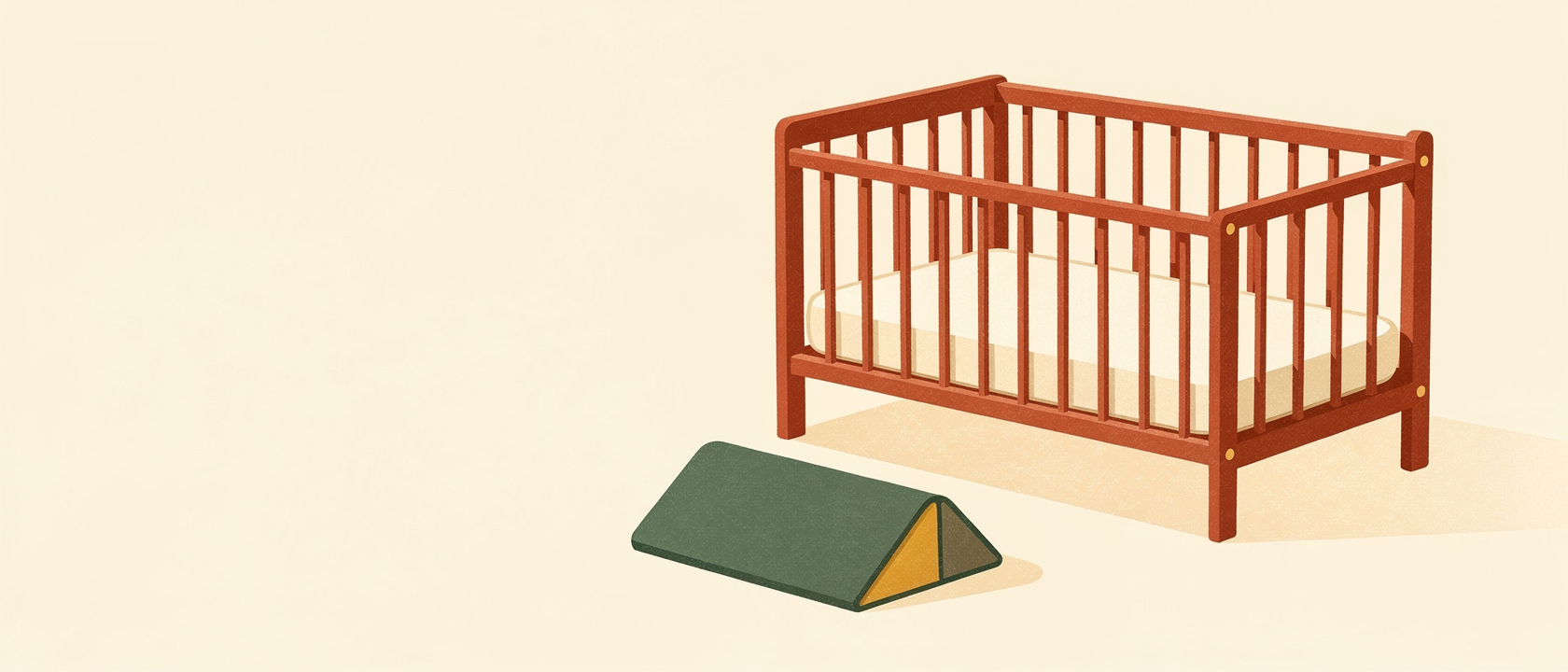
On 21 September 2026, the Office for Product Safety and Standards (OPSS) issued a serious-risk safety report on a Baby Side Sleeper Wedge with Removable Cover sold via Amazon, marketed for babies from 0 to 12 months. The listing has since been removed — but the reasoning behind the report matters more than the recall itself, because it applies to every wedge, positioner, nest or pod still for sale, not just this one product.
What was recalled
According to the OPSS notification (2609-0115), the wedge — a foam insert with a removable cotton cover, roughly 37cm wide, 42cm long and 9.5cm deep, made in China — was assessed as a serious suffocation risk when placed in an infant's sleep space. It was marketed inconsistently, with packaging suggesting 0–6 months and the listing itself suggesting 6–12 months, which OPSS flags as its own problem: the age range parents were told to trust wasn't even consistent between the box and the product page. OPSS's stated reasoning echoes long-standing NHS guidance — pillows and soft, shaped items should not go in a baby's sleep space under the age of one, because they raise the risk of overheating and airway obstruction linked to sudden infant death syndrome (SIDS). The corrective action was straightforward: Amazon removed the listing (ASIN B0DZMWYX28). OPSS's advice to anyone who already owns one is to stop using it immediately and keep it out of a baby's reach.
Why sleep positioners are never recommended, not just this one
This isn't a one-off design flaw that a better version could fix. The Lullaby Trust is explicit that it does not recommend wedges or sleep positioners at all, regardless of brand, shape, or marketing claims. Its position is that the safest place for a baby to sleep is on a firm, flat mattress, in a clear cot — free of pillows, toys, bumpers, and anything designed to wedge or strap a baby into one position. The same reasoning rules out cushioned sleeping pods, nests, and baby hammocks. The charity also points out something worth sitting with: there's no dedicated safety standard covering SIDS risk for these products, which is part of why items like this keep reaching UK shelves and marketplaces even though the evidence against the category hasn't changed in years.
The NHS's safe sleep guidance is just as direct: a baby's cot should be "clear" — a firm, flat, waterproof mattress and a well-fitting sheet, and nothing else. No pillows, no duvets, no cot bumpers, no soft toys, and no sleep-positioning products of any kind, wedges included. Check the mattress itself is firm enough by pressing it — your baby's head shouldn't sink in by more than a few millimetres. That advice hasn't shifted for years; what changes is which specific product turns up flagged on the OPSS register next.
Why these products keep getting sold despite the advice
Sleep wedges and positioners are usually marketed around reflux, flat-head prevention, or general comfort — concerns that feel real to a tired parent, even though none of them justify the suffocation risk involved. OPSS and the Lullaby Trust both point out that parents reasonably assume a product for sale on a major marketplace has already been checked for safety, when in reality third-party marketplace listings can go live, get sold for months, and only get pulled after enough reports accumulate or a spot-check catches them. This wedge was apparently on sale for some time before the September 2026 report went out. That lag is exactly why it's worth understanding the underlying rule rather than trying to track individual recalls one by one — by the time a specific product makes the news, a near-identical one under a different brand name is often already listed to replace it.
What to check if you already have one
- Any product described as a sleep wedge, positioner, nest, pod, or anything that claims to keep your baby on their back or side while sleeping unsupervised should come out of the cot, Moses basket, or crib entirely, whatever brand it is.
- If your baby has reflux or a flat-head concern, raise it with your GP or health visitor rather than reaching for an unregulated sleep product — there are supervised, non-sleep ways to manage both, and a health visitor can tell you which applies to your baby.
- Check the OPSS product safety alerts and recalls list if you're unsure whether a specific item you own has already been flagged.
- When you're choosing a cot or cot bed, focus on getting a firm, flat, well-fitting mattress right rather than adding anything on top of it — see our cot vs cot bed vs Moses basket comparison for what actually matters at each stage.
- If you swaddle or use a sleeping bag instead of loose bedding, make sure it's the right tog rating and fit rather than layering it with anything else in the cot — our swaddle vs sleep sack guide covers how to choose between the two safely.
A quick "clear cot" checklist
| In the cot | NHS/Lullaby Trust position |
|---|---|
| Firm, flat, waterproof mattress in good condition | Essential — the only surface a baby should sleep on |
| Well-fitting sheet | Fine, as long as it's fitted and can't come loose |
| Pillows, duvets, loose blankets | Not recommended under 12 months — suffocation and overheating risk |
| Cot bumpers | Not recommended — suffocation, entanglement and overheating risk |
| Soft toys, cushions | Not recommended in the sleep space, whatever the age is marketed at |
| Wedges, positioners, nests, pods, hammocks | Not recommended at any age under 12 months — this is the category this recall sits in |
The one rule that covers every future recall
Individual recalls will keep happening — new brands, new marketing angles, same underlying problem. The rule that makes each one easy to act on without waiting for a headline is the NHS's "clear cot" standard: firm, flat mattress, fitted sheet, nothing else, every sleep, until your baby's first birthday at least. If a product's entire purpose is to change how or where your baby lies while sleeping unsupervised, it doesn't belong in the cot, however reassuring the packaging looks.
Frequently asked questions
Are baby sleep wedges ever safe to use?+
No. The Lullaby Trust does not recommend sleep positioners, wedges, nests or pods for any baby under 12 months, regardless of brand or design, because they increase suffocation and overheating risk. The NHS advises a completely clear cot: a firm, flat mattress and a fitted sheet, nothing else.
What should I do if I own the recalled Amazon baby sleep wedge?+
OPSS advises stopping use immediately and keeping the product out of your baby's reach. The listing (ASIN B0DZMWYX28) has already been removed from Amazon; you don't need to contact the seller to stop using it safely.
My baby has reflux — what can I use instead of a wedge?+
Speak to your GP or health visitor rather than using an unsupervised sleep positioning product. Reflux management options exist that don't involve leaving your baby propped up while unsupervised in a cot overnight.
Sources
Related guides
Best Bedside Cribs & Moses Baskets Compared (UK)
Six bedside cribs and Moses baskets compared on price, size and lifespan: Silver Cross Lunar, Shnuggle Air Lite, SnuzPod4, HALO BassiNest, Chicco Next2Me Forever and a Mamas & Papas Moses basket. Includes the British Standards the Lullaby Trust lists and NHS safer sleep rules.
Bronchiolitis in Babies: Symptoms & When to Worry
Bronchiolitis is a common winter chest infection in babies. Here is what the NHS says about the symptoms, the signs that mean call 999 or 111, how to care for your baby at home, and how to lower the risk, including RSV protection.
Best Baby Carriers Compared (UK Guide)
Six baby carriers compared on price, age range and carry positions: Ergobaby Omni 360, Tula Free-to-Grow, Izmi, BabyBjörn Carrier Mini, Close Caboo and Momcozy Move2Fit. Includes the Lullaby Trust and RoSPA T.I.C.K.S. safety checklist.

Written by
Sepehr
Software engineer, soon-to-be dad, uncle to four — the tech-obsessed half of the two of us testing this stuff. Currently building this site with my wife, ahead of our own baby arriving.