Best Baby Gyms and Play Mats: What to Actually Check
A baby gym and a play mat aren't quite the same thing, and the 'best' one depends on your floor space and how you'll actually use it. Here's what to check before you buy, and how a play mat fits safely into your tummy time routine.
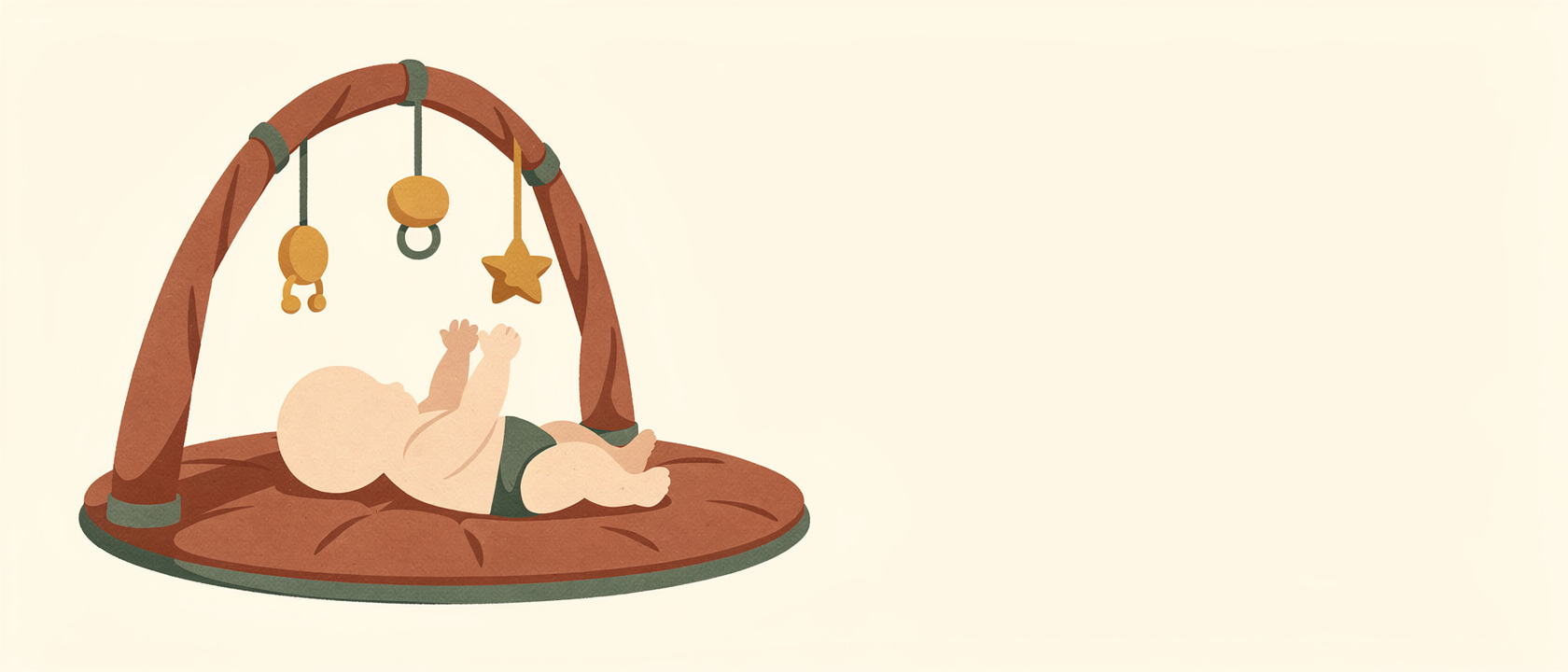
A baby gym (a mat with an overhead arch and hanging toys) and a plain play mat (just the padded surface) solve slightly different problems, and the right one for you depends more on your floor space and daily routine than on any single 'best' model. Rather than push a fixed top-5 we can't verify hands-on, here's what actually matters when you're choosing one, plus how it fits safely into tummy time.
Baby gym vs plain play mat: what's the difference
A baby gym is a padded mat with an arch (or arches) overhead that hanging toys, mirrors, and rattles clip onto — designed to give a baby on their back something to reach, bat at, and look up at. A plain play mat is just the padded floor surface, usually foam tiles or a quilted mat, with no arch — often bought separately or added to once a baby starts tummy time and no longer needs the overhead toys as much. Many parents end up with both: the gym for early back-lying play, and a larger plain mat once a baby is rolling and needs more room.
What to actually check before buying
Surface and cleanability
Look for a mat that's wipeable or machine-washable — babies dribble, spit up, and eventually eat on the floor near it. Foam-tile mats wipe clean easily but can trap crumbs in the seams; quilted fabric mats are usually machine-washable but take longer to dry. Check the manufacturer's care label before buying if this matters to your routine.
Size for your actual floor space
Baby gyms range from compact (roughly a metre across) to large enough to double as a toddler activity mat later. Measure your floor space before buying — a mat that's too large for the room it'll live in usually ends up folded away rather than used daily.
Firmness
The mat itself should be flat and firm, not deeply padded or memory-foam soft. This matters for the same reason a firm, flat sleep surface matters for safe sleep — a soft, deeply cushioned surface isn't what's being recommended here, since play mats are for supervised, awake floor play, not sleep. Firm foam tiles or a thin quilted mat over a hard floor both work; very plush, sofa-like padding is worth avoiding.
Toys, arches, and toy safety marks
If the gym has hanging or attached toys, check for a CE or UKCA mark on the packaging — RoSPA's toy safety guidance is clear that these marks are the manufacturer's claim that the toy meets UK/EU safety and choking-hazard requirements, and that toys marked unsuitable for a baby's age shouldn't be given to them regardless of how the toy looks. Avoid gyms with small detachable parts, loose pile fabric that sheds, or button batteries in easily-opened compartments, and check toys periodically for wear as your baby starts pulling and mouthing them harder. For the full breakdown of what those safety marks actually mean, see our guide on toy safety standards explained.
Portability and storage
If you'll want it in more than one room, or want to fold it away between uses, check whether the arch detaches and how compactly it packs down — some gyms fold flat in seconds, others need the arch fully dismantled.
Buying secondhand
Baby gyms and play mats are a common secondhand buy, and generally a safe one, since neither category carries the same age-critical safety-standard changes as items like car seats or cots. Still worth checking: give any fabric mat a proper wash before use, check hanging toys for cracks, loose stitching, or missing safety marks (a mark that was on the box but not the toy itself is hard to verify secondhand), and test any rattles or crinkle toys still work and haven't developed sharp edges or exposed stuffing. If a toy looks homemade, heavily repaired, or has clearly had a battery compartment opened and re-taped, it's safer to replace just that toy rather than the whole gym.
How a play mat fits into tummy time
A play mat's other main job is giving your baby a safe, flat surface for tummy time. The NHS recommends starting tummy time from birth on your chest, then moving to the floor once your baby's ready, building up little and often day by day, with the goal of around 20 to 30 minutes a day by 3 to 4 months old. Tummy time also helps reduce the risk of a flattened head shape from too much time spent lying on the back. For the full routine — including what to do if your baby resists it at first — see our guide on tummy time: when to start and how.
The one rule that applies to both a baby gym and floor-based tummy time: the NHS is clear that this is awake, supervised play only — do a check on your baby throughout, and never leave them unattended on a play mat, whether on their back or front. A play mat or gym is not a substitute for a moses basket, crib, or cot, and shouldn't be used as anywhere for a baby to fall asleep.
Budget vs premium: what actually differs
Across the price range, the core job — a firm, flat, washable surface — doesn't change much. What tends to differ at the higher end is the fabric (organic cotton or bamboo blends over synthetic quilting), reversible designs that give you two patterns from one mat, and interchangeable toy sets that let you swap the arch attachments as your baby's interests change. None of that affects safety, which comes down to the CE/UKCA marks and firmness covered above rather than price. If budget is tight, a simple foam-tile mat with no branded arch does the same core job as a mat several times the price — the arch and toys are a convenience for entertaining your baby hands-free, not a safety requirement.
When to size up or move on from a baby gym
Most babies lose interest in an overhead arch once they can reach out and grab reliably, usually somewhere around sitting age, because a fixed hanging toy is less interesting than something they can pick up, mouth, and move themselves. That's usually the point to fold the arch away (many detach) and keep the flat mat itself for sitting play, tummy time, and eventually early crawling — which needs more open floor space than the gym stage did. There's no fixed age for this changeover; it tracks your baby's own reaching and grasping development rather than a calendar date, so watch what they're actually doing with it rather than following a milestone chart.
A note on how we've assessed this
We haven't yet bought and used a baby gym or play mat ourselves, so rather than force a ranked top-5 based on specs alone, this guide focuses on the buying criteria and safety checks that hold regardless of brand — firmness, washability, size, and toy safety marks. As we buy and use specific products, we'll update this guide with hands-on comparisons and mark them accordingly, in line with how we badge every product review on this site.
The bottom line
There's no single 'best' baby gym or play mat that suits every home — a firm, flat, easy-to-clean mat sized to your floor space, with any attached toys carrying a CE or UKCA mark, covers what actually matters for safety and daily use. Beyond that, it comes down to whether you want the overhead arch (useful for early back-lying play) or a plain mat you'll size up as your baby starts rolling and needs more room.
Frequently asked questions
What's the difference between a baby gym and a play mat?+
A baby gym is a padded mat with an overhead arch that holds hanging toys, mirrors, or rattles for a baby to reach and look at while on their back. A plain play mat is just the padded floor surface without an arch, often used once a baby starts tummy time or rolling and needs more open floor space.
Is it safe to leave my baby alone on a play mat?+
No — the NHS guidance on tummy time and floor play is clear that this should only happen when your baby is awake and alert, with you there to keep an eye on them. A play mat is for supervised play, not a place to leave a baby unattended or to sleep.
What should I check before buying a baby gym with toys?+
Look for a CE or UKCA mark on any attached or hanging toys — per RoSPA's toy safety guidance, this is the manufacturer's claim that the toy meets UK/EU safety requirements. Avoid toys with small detachable parts, loose pile fabric, or easily-accessed button batteries, and check the age suitability marked on the packaging.
When should I start using a play mat for tummy time?+
The NHS says you can start tummy time from birth on your chest, moving to the floor once your baby is ready, building up gradually to around 20 to 30 minutes a day by 3 to 4 months old. A firm, flat play mat gives a comfortable, appropriate surface for the floor-based stage.
Sources
Related guides
Hooded Baby Sleeping Bags Removed From 7 UK Marketplaces
On 26 October 2026 the OPSS published seven reports on baby sleeping bags sold via Amazon, AliExpress, OnBuy, Wish, Vinted, Etsy and Joom, warning of asphyxiation and overheating risk. Here is what they say, why festive and crochet designs are affected, and how to check a listing before you buy.
Shark Tail Hooded Baby Sleeping Bag: OPSS Safety Report
On 22 October 2026 the OPSS published a serious-risk safety report on the Shark Tail Baby Sleeping Bag, a hooded baby sleeping bag sold via Wish. Here is what the report says, how to check any baby sleeping bag you own, and what the Lullaby Trust advises.
Visitors Kissing Your Newborn: Lullaby Trust Advice
New Lullaby Trust research says 57% of parents have had a baby kissed without asking. Here is the Trust's THANKS guidance on handwashing, kissing and unwell visitors for newborns, plus practical ways to set boundaries with family without causing offence.

Written by
Sepehr
Software engineer, soon-to-be dad, uncle to four — the tech-obsessed half of the two of us testing this stuff. Currently building this site with my wife, ahead of our own baby arriving.